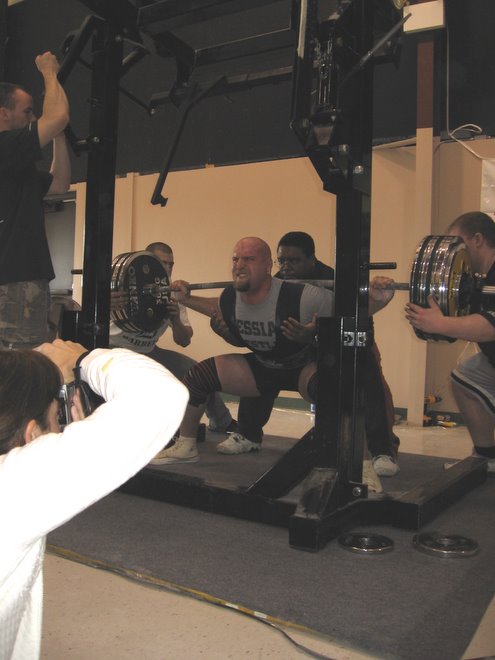
This is a pretty cool video. I really like how they track the bar path.
http://www.youtube.com/watch?v=PSyeiy99J9w
Wednesday, May 30, 2007


Thursday, May 24, 2007
Current Research
I was reading a couple of research article this morning and thought that some coaches/athletes may find this interesting.
So basically(what I always try to tell people) in order to train agility the athlete should not know the motor pattern which the are to perform. It should be as close to just reaction as possible.
Running straight does not improve COD speed, huh. Now note that this is on a predetermined course which may or may not make a difference. I am not sure how I feel about this yet. I would have to believe that it would help a little bit. This I am going to keep checking on.
Anyway there is so info to get you thinking on this sunny Thursday.
Strength and Conditioning Journal: Vol. 28, No. 5, pp. 24–29.
A Review of Agility: Practical Applications for Strength and Conditioning
Warren Young, PhD, 2006
In baseball or softball, a batter produces a rapid change of direction (COD) to run around the bases. Although this has traditionally been described as agility, it is a somewhat rare situation because the COD movement is preplanned. In most sports, such as any football code or basketball, a COD is produced in response to a stimulus such as an opponent's actions. Therefore, the speed of this movement is influenced by perceptual and decision-making factors, such as the speed of anticipation of the player. For this reason, the ability to change direction and velocity in a preplanned movement, such as in base running, may be better described as COD speed.
So basically(what I always try to tell people) in order to train agility the athlete should not know the motor pattern which the are to perform. It should be as close to just reaction as possible.
Perhaps a more important question is, does straight sprint training transfer to COD speed? Such a question was addressed in a training study by Young et al. (24). Participants performed either straight sprint training or COD sprints involving 3–5 changes of direction in a zigzag pattern over a 6-week period. It was found that the straight sprint training enhanced straight speed significantly by approximately 3%, but produced no gain in a test containing 5 changes of direction. Conversely, the COD speed training had limited transfer to straight sprinting speed. These findings can be explained by training specificity, and suggest that athletes must train specifically with the movement patterns required in their sports to benefit optimally from their training.
Running straight does not improve COD speed, huh. Now note that this is on a predetermined course which may or may not make a difference. I am not sure how I feel about this yet. I would have to believe that it would help a little bit. This I am going to keep checking on.
Anyway there is so info to get you thinking on this sunny Thursday.
Strength and Conditioning Journal: Vol. 28, No. 5, pp. 24–29.
A Review of Agility: Practical Applications for Strength and Conditioning
Warren Young, PhD, 2006
Wednesday, May 23, 2007
Speed Training
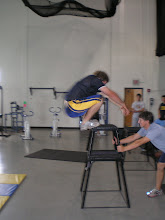
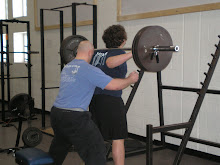
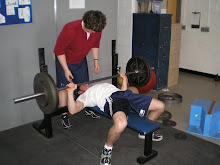
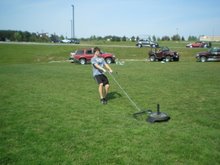
Our Tue/Thur speed training is really a combination of speed agility, explosive starting and strongman, followed up with some backyard football. Anyway I thought that I would post a few pics from yesterday, great work guys.
Matt with the "drop and walk"

Doug about to loose it

Jordan at lock out

Nate reppin it out

Tim about to press

Kevin draggin the sled

Kevin and Doug doing a reaction drill

Matt with the "drop and walk"

Doug about to loose it

Jordan at lock out

Nate reppin it out

Tim about to press

Kevin draggin the sled

Kevin and Doug doing a reaction drill

Monday, May 21, 2007
Friday, May 18, 2007

Wanna Be a Strength Coach...
There is a great on www.elitefts.com this week, i have pull some highlights, but check out the whole thing if you get a chance. Here's the link.
Here’s the scenario…
You’ve been anointed the “Strength Czar” and have been given the power over this entire industry. If you tell the world, “You have to eat dung to get strong,” everyone will believe you.
With this power, you have the opportunity to supply each coach or trainer with three things that will make them better, improve the industry, and help athletes. These three things can be anything you want—physical objects, mental characteristics, or physical characteristics—and you can use any combination of the three.
So what three things would you give people in this industry to make them better? Anything is fair game.
Mark McLaughlin (Performance Training Center, Milwaukee, Oregon): I would ban organized year-round sports for children ages 6–13. Physical education would be provided in all schools five days per week and would follow the PASM model.
Tom Deebel: Find a few people better than you and hang with them. I would make everyone get a formal education and learn biology, nutrition, kinesiology, anatomy, and strength training theory and practice.
Jim Wendler: I think a coach has to have competed at a high level in sport. The coach has to know everything that the athlete is going through, and the best way to do this is to experience it for yourself.
Travis Mash: A coach would have to participate in a mandatory weekend course with a different strength coach every six months, and the strength coach would have to be chosen from a master list that I would provide (e.g. Louie Simmons, Pavel Tsatsouline, Martin Rooney, etc.).
X’s and O’s are great when you’re trying to impress a group of college kids and convince them to pay you ridiculous amounts of their parent’s money. You can teach them about tempo, ancient Chinese diets that will up your GH levels, and give blood tests that will tell you exactly what to eat in order to operate at superhuman levels. But when it’s all said and done, lift properly, lift explosively, and lift heavier as time goes on. This isn’t rocket science. Just learn to try new things, and keep what works. If you can’t bench 315 lbs, you can’t teach me to bench 600 lbs. If you can’t run a 4.9 40-yard dash, how are you going to teach me to run a 4.3 40-yard dash? If your vertical is 20 inches, find a new job.
Julia Ladewski (University at Buffalo, Buffalo, New York): Learn from other coaches. Know your athletes. Over the years, I’ve realized that the more I know my athletes individually as people, the better response I get from them. Take the time to have casual conversations and get to know them.
Read or learn something every day whether it’s an article, a new exercise, or something else. I always find something when I’m going through old articles or stuff from other coaches.
C.J. Murphy (Total Performance Sports, Everett, Massachusetts): Intern and mentor with a good coach. The coach doesn’t have to be well known or a leader in the industry. Everyone needs to be exposed to a wide variety of training. Every coach or trainer must be a competitive athlete or had been at some point in their career.
Matt Brand (Lafayette College, Easton, Pennsylvania): Athletes are responsible for their own success. Every trainer and strength coach has to understand (as do the sport coaches who expect you to work miracles) that you can have the best plan and everything on target, but much of the responsibility falls on the athlete. If their minds and motivation are lacking, it can be very difficult to get any results.
Every strength coach and trainer needs to have experienced the training himself. A coach has to have experience failing at lifts and know what a lift feels like. This will help him coach better and get into the athletes’ minds. Also, by training, he will earn the respect of his athletes.
Nick Zostautas (Northwestern University, Evanston, Illinois): You must have an athletic background. You must have practical knowledge. You can read all the books that you want and attend all the seminars in the world, but none of it compares to getting out there and actually coaching.
Kevin Deweese (Morehead State University, Morehead, Kentucky): All coaches or trainers must have competed and trained for a competitive sport. This is essential if you want to know how training and competing coincide.
Tim Kontos (Virginia Commonwealth University, Richmond, VA): You have to have competed in some sort of strength sport. This could be powerlifting, Olympic lifting, bodybuilding, arm wrestling. It really doesn’t matter. This is what you’re coaching so you need to experience strength.
I would also enforce some kind of CEUs. You have to continue to educate yourself by watching other coaches, reading, and attending seminars.
Here’s the scenario…
You’ve been anointed the “Strength Czar” and have been given the power over this entire industry. If you tell the world, “You have to eat dung to get strong,” everyone will believe you.
With this power, you have the opportunity to supply each coach or trainer with three things that will make them better, improve the industry, and help athletes. These three things can be anything you want—physical objects, mental characteristics, or physical characteristics—and you can use any combination of the three.
So what three things would you give people in this industry to make them better? Anything is fair game.
Mark McLaughlin (Performance Training Center, Milwaukee, Oregon): I would ban organized year-round sports for children ages 6–13. Physical education would be provided in all schools five days per week and would follow the PASM model.
Tom Deebel: Find a few people better than you and hang with them. I would make everyone get a formal education and learn biology, nutrition, kinesiology, anatomy, and strength training theory and practice.
Jim Wendler: I think a coach has to have competed at a high level in sport. The coach has to know everything that the athlete is going through, and the best way to do this is to experience it for yourself.
Travis Mash: A coach would have to participate in a mandatory weekend course with a different strength coach every six months, and the strength coach would have to be chosen from a master list that I would provide (e.g. Louie Simmons, Pavel Tsatsouline, Martin Rooney, etc.).
X’s and O’s are great when you’re trying to impress a group of college kids and convince them to pay you ridiculous amounts of their parent’s money. You can teach them about tempo, ancient Chinese diets that will up your GH levels, and give blood tests that will tell you exactly what to eat in order to operate at superhuman levels. But when it’s all said and done, lift properly, lift explosively, and lift heavier as time goes on. This isn’t rocket science. Just learn to try new things, and keep what works. If you can’t bench 315 lbs, you can’t teach me to bench 600 lbs. If you can’t run a 4.9 40-yard dash, how are you going to teach me to run a 4.3 40-yard dash? If your vertical is 20 inches, find a new job.
Julia Ladewski (University at Buffalo, Buffalo, New York): Learn from other coaches. Know your athletes. Over the years, I’ve realized that the more I know my athletes individually as people, the better response I get from them. Take the time to have casual conversations and get to know them.
Read or learn something every day whether it’s an article, a new exercise, or something else. I always find something when I’m going through old articles or stuff from other coaches.
C.J. Murphy (Total Performance Sports, Everett, Massachusetts): Intern and mentor with a good coach. The coach doesn’t have to be well known or a leader in the industry. Everyone needs to be exposed to a wide variety of training. Every coach or trainer must be a competitive athlete or had been at some point in their career.
Matt Brand (Lafayette College, Easton, Pennsylvania): Athletes are responsible for their own success. Every trainer and strength coach has to understand (as do the sport coaches who expect you to work miracles) that you can have the best plan and everything on target, but much of the responsibility falls on the athlete. If their minds and motivation are lacking, it can be very difficult to get any results.
Every strength coach and trainer needs to have experienced the training himself. A coach has to have experience failing at lifts and know what a lift feels like. This will help him coach better and get into the athletes’ minds. Also, by training, he will earn the respect of his athletes.
Nick Zostautas (Northwestern University, Evanston, Illinois): You must have an athletic background. You must have practical knowledge. You can read all the books that you want and attend all the seminars in the world, but none of it compares to getting out there and actually coaching.
Kevin Deweese (Morehead State University, Morehead, Kentucky): All coaches or trainers must have competed and trained for a competitive sport. This is essential if you want to know how training and competing coincide.
Tim Kontos (Virginia Commonwealth University, Richmond, VA): You have to have competed in some sort of strength sport. This could be powerlifting, Olympic lifting, bodybuilding, arm wrestling. It really doesn’t matter. This is what you’re coaching so you need to experience strength.
I would also enforce some kind of CEUs. You have to continue to educate yourself by watching other coaches, reading, and attending seminars.
Thursday, May 17, 2007
Training Camaron
Camaron is a college basketball player that I had the pleasure of training almost right out of college. He was enrolled in a summer program that i started. Since then he has had success on the court and is looking to make this season a great one. I will be training Camaron online via e-mail and this blog with the intent of show different options as far as training.
His goal is to increase his weight this summer while keep his speed and agility. I have already sent him his workout for the first few weeks, and if I ever figure out how to post excel documents on here I will post it up. His current weight is at 200, and we are looking to gain 15-20 pounds by the end of summer and up to 25 by season.
This is very possible but will not be easy, and it will start with nutrition. My approach to nutrition has always been, just use common sense. Everyone knows what to eat, they just want to eat other stuff. What I will do here, is throughout the summer I will be making recommendations to Camaron to help change his diet. Rather than make a whole lot at once we will try to implement one change a week, and I will post those here.
First change: Never feel hungry. This means you need to eat constantly, 5-6 meals a day and snacking in between. I am not worried about what you eat, but try using common sense, McDonald's is not a good choice.
His goal is to increase his weight this summer while keep his speed and agility. I have already sent him his workout for the first few weeks, and if I ever figure out how to post excel documents on here I will post it up. His current weight is at 200, and we are looking to gain 15-20 pounds by the end of summer and up to 25 by season.
This is very possible but will not be easy, and it will start with nutrition. My approach to nutrition has always been, just use common sense. Everyone knows what to eat, they just want to eat other stuff. What I will do here, is throughout the summer I will be making recommendations to Camaron to help change his diet. Rather than make a whole lot at once we will try to implement one change a week, and I will post those here.
First change: Never feel hungry. This means you need to eat constantly, 5-6 meals a day and snacking in between. I am not worried about what you eat, but try using common sense, McDonald's is not a good choice.
Monday, May 14, 2007
Comments
So I was informed on Friday that you could not leave a comment without being a blogspot member. Well I have changed that, now anyone can comment on either this blog, my articles, or my workouts. Also if you want, you can still e-mail.
My Work Outs
I created another blog, which I will keep as a workout blog. I have been getting questions about what I do for training so now here it is. Also, the place I used to record them crashed so I was going to need to start over anyway. Feel free to comment on any workout you want.
Thursday, May 10, 2007
Good Stuff
This is a good article, albeit that it is directed toward women, but all can learn from it, take a look.
SQUATTING MYTHS
SQUATTING MYTHS
Subscribe to:
Posts (Atom)